

Why Trout Die in Peak Summer Heat: The Science, the Warning Signs, and How to Stop It
Last month, we looked at why Manitoba ponds turn green in July. This month, the same heat that fuels algae is working against a very different kind of water body — the trout ponds, fishery lakes, and stocked dugouts that depend on cold, oxygen-rich water to keep fish alive.
Trout are not built for August. Unlike bass, perch, or koi, they're a coldwater species with a narrow comfort zone — and when a Manitoba summer pushes surface temperatures past that zone, the failure isn't always dramatic. It's often quiet: a few fish hanging at the surface one evening, a handful found floating the next morning, and a pond owner left wondering what changed overnight. Nothing changed overnight. The conditions had been building for weeks.
Every August, the same phone call comes in. A stocked trout pond that looked perfect in June suddenly has fish gasping at the surface, or worse, floating. The instinct is to blame disease, a bad batch of stock, or vandalism. In the overwhelming majority of cases, it's none of those things. It's the water itself, and the physics behind it are well understood, well documented, and largely preventable.
This piece goes further than the usual "run an aerator" advice. We wanted to explain the actual biology and physics driving trout die-offs, using the same fisheries science hatcheries and stream researchers rely on, so pond owners can see exactly why the interventions work, not just that they do.
A Coldwater Fish in a Warmwater Land
Trout evolved in cold, fast-moving, oxygen-saturated streams and spring-fed lakes, and their entire physiology is tuned to that environment. Research reviewing decades of hatchery and field studies puts the optimal growth range for rainbow trout at roughly 15–19°C. Fish can survive and even feed reasonably well several degrees above that, but growth slows, appetite drops, and stress hormones climb the further the water strays from that band.
The upper limit is where things get serious, and it varies more than most pond owners expect. Literature reviews of rainbow trout place the upper incipient lethal temperature, the point at which prolonged exposure becomes fatal, somewhere between 25 and 30°C depending on strain and how gradually the fish were acclimated. Brook trout tend to top out a little lower, with field-based estimates putting their upper thermal tolerance around 25°C. Brown trout are frequently the most heat-sensitive of the three: in controlled trials examining abrupt temperature increases, brown trout showed sharply reduced survival once water crossed roughly 20°C, and none survived a jump to 22°C. The takeaway for anyone managing a mixed or brown-trout-heavy fishery is that the safety margin is narrower than the "trout can handle 25°C" rule of thumb suggests.
Thermal Comfort Zones by Trout Species
Oxygen — The Hidden Half of the Equation
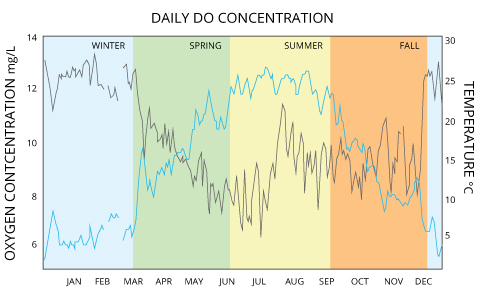
Heat alone rarely kills a trout population outright. What usually finishes the job is oxygen and the two problems are physically linked. Warmer water simply cannot hold as much dissolved oxygen as cold water. At 10°C, water can carry roughly 11 mg/L of oxygen at saturation. By 20°C, that ceiling drops to around 9 mg/L. By 30°C, it's closer to 7.5 mg/L, a meaningful loss of oxygen-carrying capacity, arriving at the exact moment trout need more oxygen, not less.
Here's the physics most pond owners never hear explained: warm water simply holds less dissolved oxygen than cold water. That isn't a biological quirk of trout, it's a property of water itself. Older but still widely cited fisheries research established that rainbow trout need oxygen levels above 7 mg/L when water is under 15°C, and above 9 mg/L once it exceeds that. Separate work reviewing salmonid swimming performance found that fitness is maximized only when the daily minimum dissolved oxygen stays above roughly 8–9 mg/L, and that swimming speed can drop by 30 percent or more once oxygen falls into the 5 mg/L range, even at otherwise tolerable temperatures.
Put those two facts together and the trap becomes obvious. As a pond warms through the day, the water's ability to hold oxygen declines at the exact moment trout need more of it to cope with heat stress. A pond that reads perfectly healthy at 8am can be functionally dangerous by 4pm, and the fish have nowhere further to swim to escape it.
What's Actually Happening Beneath the Surface
On a calm, hot day, a pond doesn't heat evenly from top to bottom. The sun warms a shallow surface layer while deeper water stays cooler, and because warm water is less dense, it floats on top instead of mixing down. Extension research on pond management describes this layering, called thermal stratification, as most pronounced in ponds deeper than roughly six to eight feet, exactly the depth range common in stocked fishery ponds and storm retention ponds.
A Stratified Pond on a Hot, Still Day
When the Pond Turns Over
Stratification on its own is dangerous but survivable if it holds steady. The real crisis happens when it breaks suddenly. Extension fisheries specialists describe the sequence consistently: after several calm, hot days, a thunderstorm or a strong cold front rolls in. Wind and cooling rain force the warm surface layer and the cold, oxygen-starved bottom layer to mix rapidly, and dissolved oxygen across the entire water column crashes within hours. One extension summary notes that a severe turnover can kill nearly every larger fish in a pond in a single night, and that it isn't uncommon to find dead fish that had swum up an inflowing creek chasing the last available oxygen before they died.
Fisheries extension guidance places the fish-stress threshold at dissolved oxygen below roughly 3 mg/L, with mass die-offs becoming likely below 2 mg/L. Trout, being more oxygen-demanding than typical warmwater pond species, often show trouble well before those numbers are reached — another reason midday readings can be misleading.

The Warning Signs Before a Kill
Trout usually signal distress before you find fish belly-up. The signs are subtle enough that most owners miss them until the pattern is already well underway.
Surface gasping. Fish hanging at the surface or crowding near inlets, spillways, or aerators, working to breathe.
Lethargy and appetite loss. Fish resting on the bottom in shaded areas and ignoring feed during the hottest part of the day.
Post-storm losses. A kill that appears within 12–24 hours of a storm or cold front following several still, hot days.
Water quality shifts. Darkening or greenish water, a sudden rotten-egg odor from the bottom layer, or a collapsing algae bloom.
Testing It Right
Dissolved oxygen is lowest right before sunrise, after a full night of respiration by fish, algae, and bacteria with no photosynthesis to replenish it, and highest in the late afternoon after hours of sunlight. A midday reading can look reassuring while the dawn number tells a completely different story. If you only test once a day, test at dawn.
Condition | Approx. dissolved oxygen | What it means for trout |
|---|---|---|
Optimal | 7–9+ mg/L | Full activity, feeding, and growth |
Reduced performance | 5–7 mg/L | Swimming speed and feeding measurably decline |
Stress | 3–5 mg/L | Fish crowd near aerators or inflows, appetite drops sharply |
Danger | Below 3 mg/L | Risk of mortality rises quickly, especially combined with heat |
Managing It Better: What Actually Works
None of this means a trout fishery can't survive a prairie summer. It means the work has to happen before the heat arrives, not after the first fish is found floating.
Aerate before the heat, not during the crisis
Continuous aeration is the single most effective tool against summer fish kills, because it does two things at once: it breaks up thermal stratification before it can lock in, and it mixes atmospheric oxygen through the full water column instead of leaving it trapped near the surface. Extension research on turnover prevention specifically recommends mechanical aeration, ideally with bottom diffusers rather than surface-only fountains, since bottom aeration disrupts the layering that causes turnovers in the first place. Systems like the Airmax PS10 and PS20 are sized for larger fishery ponds, while the KoiAir line works well for shallower water gardens. Run them around the clock through July and August, not just when fish look stressed.
Build in cool-water refuge
Deeper pockets, spring-fed inflows, and shaded shoreline sections give trout somewhere to retreat to when the main body of water climbs past their comfort zone. Field research on stream pools found trout consistently sought out the coolest available water even when it meant tolerating lower oxygen, which underscores how much thermal refuge matters when it's genuinely available. Shoreline plantings and partial shade structures on the south-facing bank make a measurable difference.
Ease off feeding and handling during heat spikes
Digestion raises a fish's metabolic rate and oxygen demand. On the hottest days, cut back feeding, and avoid netting, stocking, or tournament activity that adds handling stress on top of thermal stress. Save that activity for early morning when water is coolest and oxygen, despite being at its daily low, is at least not compounded by added exertion.
Test at dawn and track the trend, not just the number
A single reading tells you where you stand today. A dawn reading tracked across a week tells you whether the pond is drifting toward trouble. Pair regular testing with treatments that reduce oxygen-robbing muck and nutrient buildup, like CWP Muck Remover Plus or Phosphate Binder Plus, so the whole system isn't working against your fish before the heat even arrives.
Have a plan for storm turnover
After a stretch of hot, still weather, watch the forecast. A strong storm or sudden wind event is exactly when a stratified pond can flip. Keep emergency aeration ready to deploy, and check on your fish the morning after any big weather change during a heat wave. If you suspect a turnover is underway, aerate immediately and continuously rather than waiting to confirm it with a test kit first.
Match your management to your species
If your fishery carries brown trout alongside rainbow or brook trout, treat the brown trout as your early-warning species. Their narrower thermal margin means they show stress before the more heat-tolerant strains do, so a brown trout that stops feeding is worth taking seriously even if the rest of the pond still looks fine.

Don't Wait for the Fish to Tell You There's a Problem
Every fishery is different, and the right aeration and management plan depends on your pond's depth, stocking density, species mix, and exposure. Let's build a plan before the next heat wave hits.